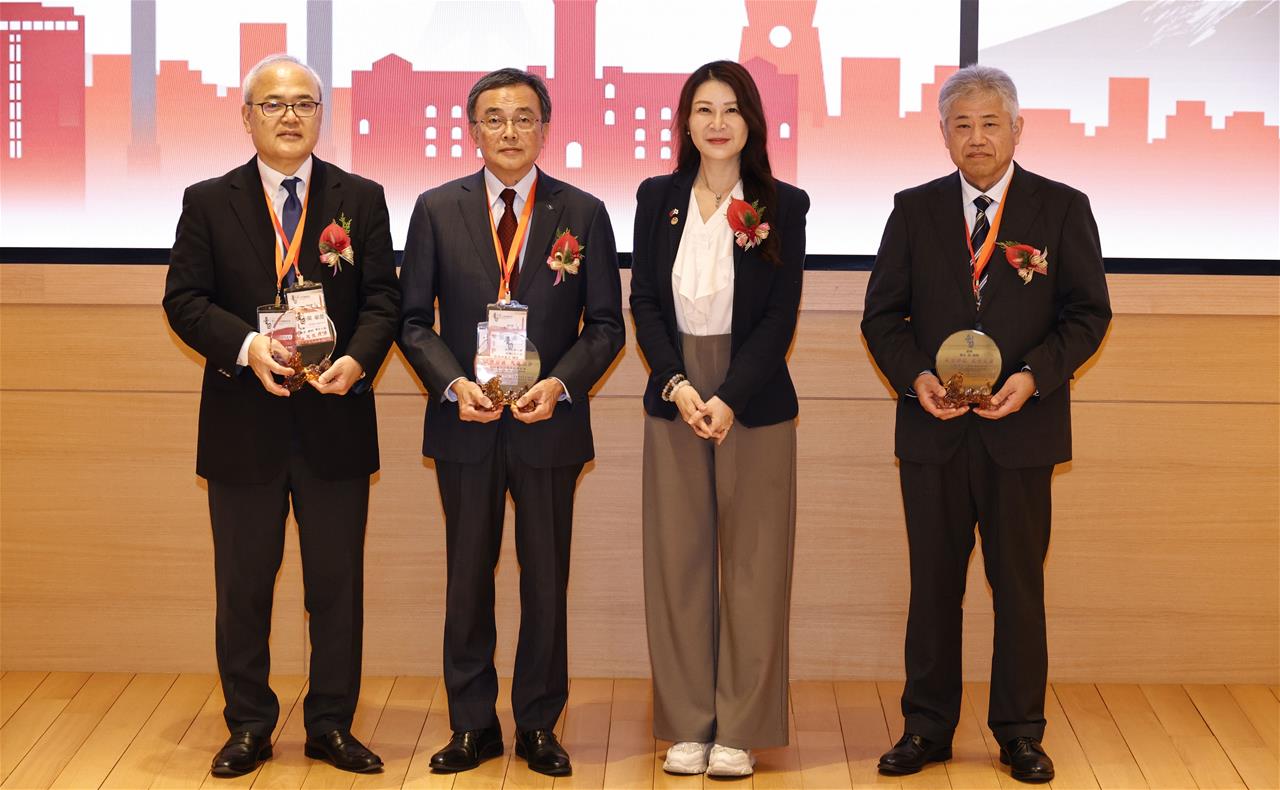
The Metal Industries Research & Development Centre (MIRDC) and China Steel Corporation (CSC) jointly held the 35th Taiwan-Japanese Modern Engineering and Technology Symposium - Metal Session today, the 18th, at the International Conference Halls of CSC’s headquarters. Aligned with the theme of the conference, Technology Leading to Sustainable Development, Japanese experts and scholars were invited to share the latest research findings and industry trends on advanced technologies such as low-carbon metal recycling materials, high-value metal processing, and industrial energy-saving applications.
Since its establishment in 1980, the Taiwan-Japanese Modern Engineering and Technology Symposium has served as a vital platform for technology exchange between Taiwan and Japan. In her opening remarks, Chia-Ju Liu, Chairman of MIRDC, highlighted that Taiwan is at a critical juncture in its net-zero transition and its pursuit of industrial sustainability. Key strategies for enhancing industrial resilience include circular economy, high-value metals, low-carbon processes, and hydrogen applications. Research insights from Japanese experts, along with MIRDC and CSC’s capabilities in metal materials development and industrial applications, are expected to deepen collaboration between Taiwan and Japan and accelerate Taiwan’s net-zero transition and sustainable development in the metal industry.
This year's Metal Session focused on two main themes: metal materials and industrial energy savings. Six top Japanese academics and experts from benchmark enterprises were invited to deliver keynote presentations. In the field of metal materials, Kumai Shinji, Professor of Institute of Science Tokyo, discussed the current situation and future prospects of aluminum scrap recycling technology, focusing on Japan’s technological advancements in high-grade recycled aluminum. Nagasaka Tetsuya, Professor of Tohoku University, addressed the technological challenges and solutions for aluminum recycling from the perspective of resource flow. Koseki Toshihiko, Vice President of University of Tokyo, explored advanced aerospace alloys and manufacturing technologies that guide the development trends of high-value industries.
In the field of industrial energy savings, Yamada Takashi, Chief Technology Officer of JSOL Corp., renowned for its electromagnetic materials simulation software, shared the latest advancements in integrated simulations for next-generation motors and materials, providing insights into design strategies to create high-power, low-energy-consumption, and compact systems. Maruta Harunori, Section Chief of Fuji Electric Co., Ltd., a leading manufacturer of industrial furnaces and heating equipment, introduced the latest energy saving technologies for electric heating furnace, presenting solutions for low-carbon transition in the metal industry. Focusing on hydrogen applications, Suzuki Yutaka, President of WELCON Inc., shared the technological approaches to microchannel structure fabrication via diffusion welding and presented the company’s achievements in developing heat exchangers for hydrogen refueling stations.
In addition to the symposium presentations, Japanese experts engaged in technological exchanges and collaboration discussions with MIRDC. Ping-Kuo Cheng, Director of MIRDC’s Metal Processing R&D Department, led a technical team to explore potential collaboration opportunities with Japanese experts for aluminum recycling and aerospace component manufacturing. Hun-Yu Lin, Director of MIRDC, led the Industrial Upgrading Service Department in extensive discussions with Japanese experts on advanced topics, including hydrogen energy and burner design, to strengthen dialogue and build consensus for future collaboration in industrial technologies.
Taiwan and Japan have a long history of collaboration in industrial and technological development, addressing global economic growth and net-zero sustainability challenges together. This symposium offered Taiwanese businesses valuable insights into innovative low-carbon metal materials and energy-saving process equipment and applications. The advanced research and industry trends shared by Japanese experts during the event contributed to deeper industrial and technological exchanges and cooperation between Taiwan and Japan.