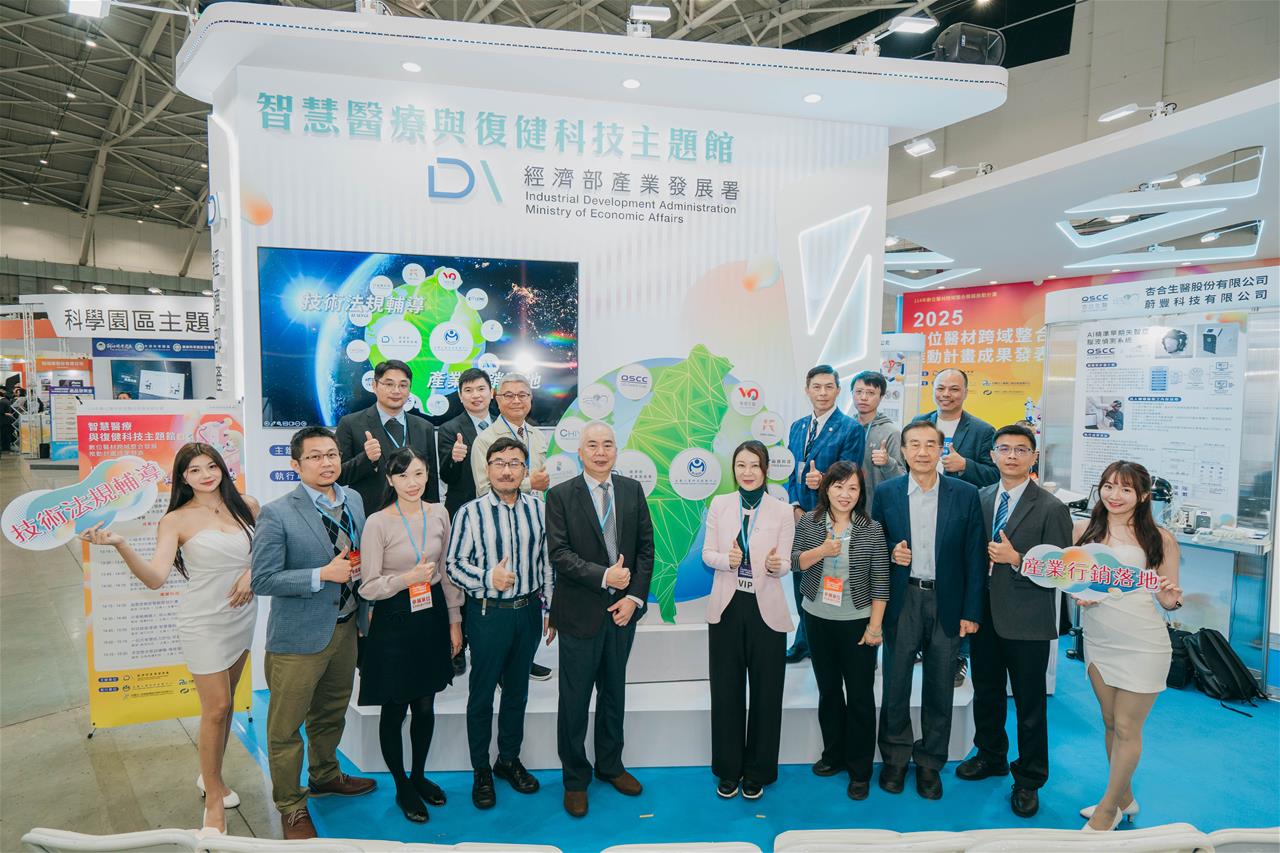
The Industrial Development Administration (IDA), Ministry of Economic Affairs commissioned the Metal Industries Research & Development Centre (MIRDC) to implement the IDA's “Digital Medical Device Cross-Domain Integration and Development Project,” which aims to develop Taiwan's high-value and digital medical device industry, and enhance the international competitiveness of Taiwan's overall medical device industry. The IDA and MIRDC jointly set up the “Smart Healthcare and Rehabilitation Technology Pavilion” at the 2025 Healthcare+ Expo Taiwan at Nangang Exhibition Center on December 4, 2025. Twelve smart healthcare and rehabilitation technology companies were invited to present Taiwan's smart medical devices for the entire healthcare process in clinical scenarios from early detection → clinical diagnosis → surgery → functional rehabilitation, showing Taiwan’s actual results in accelerating the process from R&D to clinical application of smart healthcare technology.
A total of 10 products were showcased at the event, including precise dementia risk detection by AI, determination of upper airway obstruction by AI, precision genetic testing, contactless surgical lighting systems, gynecological hydrogel expanders, AI-based knee prostheses, neurostimulation therapy equipment, AI-based muscle testing, joint training, and gait training with a safety suspension device, each corresponding to needs in different clinical stages. In the field of rehabilitation, the companies also showcased intelligent prostheses and neuro-electrical stimulation, muscle testing, and gait training systems at the event, which can be used to provide rehabilitation solutions for mild, moderate, and severe cases.
Chia-Ju Liu, Chairman of MIRDC, said that the integration was carried out by a team led by Tzyy-Ker Sue, Director of MIRDC's Medical Devices R&D Service Department, with key members including Assistant Section Chief Yu-Chueh Wang and Dr. Bol-Wei Huang. The team accelerated the development of smart medical devices from prototype verification to clinical application and market deployment through clinical needs assessment, field data feedback, and cross-domain system integration. Competition in smart healthcare is no longer about single products, but rather about moving from “reinforcing individual technologies” to “incorporating clinical needs and cross-domain integration for clinical application.” This will allow smart medical devices in Taiwan to move forward from merely being showcased at exhibitions to proof of concept, optimization, and use, effectively shortening the time from R&D to clinical application of smart medical devices, which will elevate Taiwan's position and enhance its competitiveness in the global supply chain of smart healthcare.